Buying guide Updated 2026
The Best Floor Safes of 2026
A real floor safe isn't bolted to the floor. It's buried in it: set into a concrete slab so only the door shows, flush with the floor and hidden under a rug. A thief can't carry it off or tip it over to pry the back, because there is no back to reach. The Hayman FS2300B is our main pick, a mid-size in-floor safe with a 1/2-inch steel door and a body Hayman describes as water-tight against ground water. The Hayman S1200B is the small one for cash and jewelry, the FS4000B holds files, and the Protex IF-1500C is the pick if you want a steel body instead of polyethylene. Know two things before you buy. You need a concrete slab and a weekend of concrete work, or a contractor. And none of these four carries a UL burglary or fire rating; the concrete around the safe does most of the work.
At a glance - 4 in-floor safes compared
| Safe | Best for | Interior space (maker) | Lock | Door | Body |
|---|---|---|---|---|---|
| Hayman FS2300B Check price | Best overall | 2,096 cu in (about 1.2 cu ft) | UL-listed combination dial | 1/2-in steel, lift-off hinge | Polyethylene, water-tight per Hayman |
| Hayman S1200B Check price | Small: cash, jewelry, a passport | 1,104 cu in (about 0.6 cu ft) | UL-listed combination dial | 1/2-in steel, lift-out | Polyethylene, water-tight per Hayman |
| Hayman FS4000B Check price | Most room, holds files | 3,861 cu in (about 2.2 cu ft) | UL-listed combination dial | 1/2-in steel, lift-off hinge | Polyethylene |
| Protex IF-1500C Check price | Steel body, five locking bolts | 0.70 cu ft | LaGard Group II combination | 1/2-in A36 solid steel | Steel, anchor base plate |
Floor safe or bolt-down safe?
Search Amazon for "floor safe" and half the results are ordinary box safes that you bolt to the floor. Those are fine safes, but they sit on top of the floor where a thief can see them, get a pry bar behind them, and work on the anchor bolts. An in-floor safe is a different design. The body is sunk into the slab and surrounded by new concrete, so the only part a burglar can touch is a steel door at floor level. Hayman's install guide puts it plainly: the more reinforced concrete you place around the safe, the greater the security. If you can't cut into concrete, or you want a fire-rated document safe, a bolt-down fire safe is the better buy. Our fireproof safes guide covers those.
How a floor safe is installed
These steps come from Hayman's own in-floor safe guide, for setting a safe into an existing concrete slab. Other makers' safes go in the same basic way, but follow the instructions that ship with yours.
- Take the door off first and store it out of the way. It goes back on only after the concrete has set.
- Tape the steel dust cover over the opening, still in its plastic wrap, with duct tape around the corners and over the top edge so wet concrete can't seep in.
- Cut a hole in the slab about 3 inches larger than the safe on every side. That means adding 6 inches to the safe's listed width and depth.
- Dig out underneath to about 3 inches below where the bottom of the safe will sit.
- Partly fill the hole with concrete, set the safe in, and push it down until the top is level with the finished floor.
- Fill the rest of the hole with concrete around the safe, keeping the top level with the floor.
- If water could ever run across that spot, set the safe slightly above floor level and taper the concrete up to the dust cover instead.
Cutting a slab means a concrete saw, demolition work and mixing concrete. If that's more than you want to take on, a concrete contractor or a locksmith who does safe work can install it. Hayman notes that improper installation can void both its burglary and fire guarantees, which is one more reason to get it right. For what locksmith labor typically runs, see our locksmith cost guide.
What a floor safe won't do
- It doesn't have a fire rating. None of these four carries a UL fire rating. Hayman instead offers a written guarantee to repair or replace the safe if the contents are damaged by fire. That's a promise from the maker, not a lab test, so keep irreplaceable papers in a UL-rated fire safe or keep copies elsewhere.
- It doesn't have a burglary rating. The locks are UL-listed, but none of the four safes is listed under UL's safe burglary standards, such as the UL 1037 Residential Security Container test. The concrete does the job a rating would otherwise prove.
- It isn't big. Even the largest pick here holds a little over 2 cubic feet. Floor safes are for cash, jewelry, documents and drives, not long guns.
- It isn't quick to open. You kneel, lift the cover, and work a dial at floor level. That's fine for valuables, and wrong for anything you need in a hurry.
The picks

1. Hayman FS2300B In-Floor Safe
The size most households want: Hayman lists 2,096 cubic inches inside, enough for a stack of documents, cash, jewelry and a few hard drives. The door is 1/2-inch solid steel in a 1/4-inch steel frame, on a hinge that lifts off for installation, and the body is polyethylene that Hayman describes as water-tight from ground water. That matters for a box that will spend its life buried in concrete. It opens on a UL-listed combination dial, with an electronic lock available from Hayman, and has a relocker and hard plate behind the door. Hayman backs it with a lifetime burglary guarantee. There is no UL rating on the safe itself, and Amazon lists it as "FS2300B" while Hayman's page calls it "FS 2300 B C". The specs match, but check the listing before you order.
Pros
- 1/2-inch solid steel door in a 1/4-inch frame
- Polyethylene body Hayman describes as water-tight from ground water
- UL-listed combination lock with a relocker and hard plate
- Lifetime burglary guarantee from Hayman
Cons
- No UL burglary or fire rating on the safe itself
- Needs a concrete slab and a real install job
- Hayman doesn't state that its "FS 2300 B C" page and the Amazon "FS2300B" are the same SKU

2. Hayman S1200B In-Floor Safe
The smallest Hayman here, at 1,104 cubic inches inside (14 1/2 by 8 1/8 by 9 3/8 inches). That's room for cash, jewelry, a passport and a few small drives, but not file folders. Its 1/2-inch steel door has no hinge at all. You unlock it and lift it straight out, which keeps the opening flush and simple. It uses the same UL-listed combination dial, relocker, hard plate and water-tight polyethylene body as the FS2300B, comes with shelves, and carries Hayman's lifetime burglary guarantee. A smaller safe also means a smaller hole to cut, which makes it the easiest of the four to install.
Pros
- Smallest footprint here, so the smallest hole to cut
- Lift-out door with no hinge
- Same UL-listed lock and water-tight polyethylene body as the FS2300B
- Shelves included
Cons
- Too small for file folders
- No UL burglary or fire rating on the safe itself

3. Hayman FS4000B In-Floor Safe
The pick if the safe is for paperwork. Hayman lists 3,861 cubic inches inside, with three fixed shelves, vertical filing with a movable divider, and a false floor that you can cover with carpet to hide what's underneath. The outside measures 21 3/4 by 15 1/2 by 20 inches and weighs 90 pounds before any concrete goes around it, so plan for a bigger hole. It ships with a wood brace that you wedge inside during the pour so the wet concrete doesn't bow the walls in. The lock, door and guarantee match the FS2300B, and Hayman offers thicker 1-inch and 1 1/2-inch doors.
Pros
- The most interior space of the four
- Vertical file storage plus a hidden false floor
- Thicker door options available from Hayman
- Lifetime burglary guarantee
Cons
- Largest hole to cut and the most concrete to pour
- No UL burglary or fire rating on the safe itself
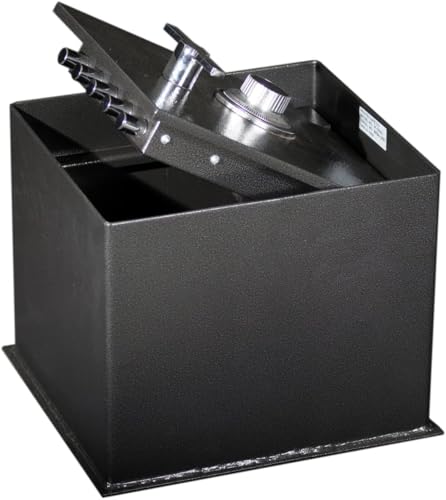
4. Protex IF-1500C In-Floor Safe
If you'd rather bury steel than plastic, this is the alternative. Protex builds the body in steel with an anchor base plate and a lipped bottom plate to lock it into the concrete. The 1/2-inch A36 solid steel door throws five 3/4-inch chrome bolts and adds a dead bar, spring relocker and carburized hard plate. It opens on a LaGard Group II combination lock and ships with a steel cover. The interior is 13 7/8 by 13 1/2 by 7 inches, or 0.70 cubic feet, and the safe weighs 78 pounds. Protex makes no water-tightness claim for the body, so don't put it where water collects.
Pros
- Steel body with an anchor base plate
- Five 3/4-inch locking bolts plus a dead bar
- Relocker and hard plate behind a 1/2-inch steel door
- Steel cover included
Cons
- No water-tightness claim from Protex
- Shallow interior, at 7 inches deep
- No UL burglary or fire rating
Our pick: Hayman FS2300B In-Floor Safe
For most homes with a concrete slab, the Hayman FS2300B is the floor safe to buy. It's big enough for documents and valuables, has a solid 1/2-inch door, and its polyethylene body is built to sit in concrete without letting ground water in. Go smaller with the S1200B if it's only cash and jewelry, or larger with the FS4000B if you need to store files. Pick the Protex IF-1500C if you specifically want a steel body. Whichever you choose, the install decides how secure it is: surround it with as much reinforced concrete as the hole allows, and keep it somewhere dry.
We may earn a commission on qualifying purchases made through links on this page, at no extra cost to you. It never affects which product we recommend. Learn more.
Product prices and availability are accurate as of the date/time indicated and are subject to change. Any price and availability information displayed on Amazon.com at the time of purchase will apply to the purchase of this product. Certain content that appears on this site comes from Amazon. This content is provided ‘as is’ and is subject to change or removal at any time.
Frequently asked questions
- What is a floor safe?
- A floor safe, or in-floor safe, is set into a concrete slab so its top sits flush with the floor and only the door is exposed. New concrete is poured around the body, so the safe can't be lifted out, tipped over or pried from the sides. Many people hide the door under a rug or carpet tile.
- Can you put a floor safe in an existing concrete floor?
- Yes. Hayman's instructions cover exactly that: cut a hole about 3 inches larger than the safe on each side, dig to about 3 inches below it, set the safe level with the floor in fresh concrete, then fill in around it. It's real concrete work, so many people hire a contractor or a locksmith who installs safes.
- Are floor safes fireproof?
- No safe is fireproof, and none of the four floor safes here has a UL fire rating. Hayman offers a written guarantee to repair or replace its in-floor safes if the contents are damaged by fire, and notes that improper installation can void it. For irreplaceable papers, a UL-rated fire safe is the safer choice.
- Will a floor safe get wet inside?
- It depends on the body. Hayman describes its polyethylene bodies as water-tight from ground water, and its guide says that if water could run across the spot, you should set the safe slightly above floor level and taper the concrete up to it. Protex makes no water-tightness claim for its steel-body IF-1500C, so pick a dry location for it.
- Is a floor safe better than a bolt-down safe?
- For theft, usually yes. A bolt-down safe sits on top of the floor, where a thief can see it and attack the bolts or the back. An in-floor safe is surrounded by concrete with only the door exposed. A bolt-down safe is easier to install, holds more, and can carry a UL fire rating, so it's the better choice when fire protection matters most.
- Can I put a floor safe in a wood floor?
- The safes on this page are designed to be set in concrete, and the install steps assume a concrete slab. In a house with a wood subfloor, that usually means the garage or basement slab.
Related
Sources
- Hayman Safe Co. - In-Floor Safe Operation Guide (installation steps, guarantees)
- Hayman Safe Co. - Floor safe product line
- Hayman Safe Co. - FS 2300 B C
- Hayman Safe Co. - S 1200 B C
- Hayman Safe Co. - FS 4000 B C
- Protex Safe Co. - IF-1500C in-floor safe
- UL Solutions - Residential Security Container standard (UL 1037)
- Amazon - Hayman FS2300B
- Amazon - Hayman S1200B
- Amazon - Hayman FS4000B
- Amazon - Protex IF-1500C
Specs and prices are compiled from the sources above and current as of the update date. Availability and pricing change — confirm on the retailer page before buying.