2019 Buick Regal Key Fob Programming
Updated 2026 Programming, battery & replacement fob
You can program a 2019 Buick Regal key fob yourself in a few minutes using a working key or remote, no dealer visit needed. Follow the steps below, then check the battery and the correct replacement fob (with FCC ID and part number) if you need a new one.
If your GM vehicle (Cadillac, Chevrolet, Buick) has push-button start, you can program smart keys yourself. Use Method A if you have two working smart keys; use Method B if you have one or none. Up to 8 smart keys — read the steps through first.
Before you start
- All smart keys — working and new — with you
- Engine off
Method A — with two working smart keys
- 1Remove the emergency key blade from one of the working smart keys.
- 2Place both working smart keys in the cupholder.
- 3Insert the emergency key blade into the driver's-door lock cylinder and turn it counterclockwise to unlock five times within 10 seconds. (On some vehicles you'll first pop off the lock-cylinder cap on the door handle.) The Driver Information Center shows READY FOR REMOTE #2.
- 4Place the new smart key in the transmitter pocket — center-console storage for Cadillac, front cupholder for Chevrolet and Buick.
- 5Press ENGINE START/STOP. When the key is recognized, the display is ready for the next key.
- 6Take the key out of the pocket and press Lock or Unlock on it.
- 7To add another key, repeat the last three steps. When done, press and hold ENGINE START/STOP about 12 seconds to exit.
Method B — with one or no working smart key
Takes about 30 minutes and isn't available in Canada. With no working key, have the new key's emergency blade cut by a locksmith first.
- 1Remove the key blade from your existing or new smart key.
- 2Insert it into the driver's-door lock cylinder and turn counterclockwise to unlock five times within 10 seconds. The display shows READY FOR REMOTE.
- 3Wait about 10 minutes until the display reads PRESS ENGINE START BUTTON TO LEARN, then press ENGINE START/STOP. The display shows REMOTE LEARN PENDING, PLEASE WAIT.
- 4Repeat that door-cylinder, wait, and Start/Stop sequence two more times. After the third, all previously known keys stop working and the display shows READY FOR REMOTE #1.
- 5Place the new smart key in the transmitter pocket — center console for Cadillac, front cupholder for Chevrolet and Buick.
- 6Press ENGINE START/STOP. When recognized, the display is ready for the next key.
- 7Take the key out and press Lock or Unlock on it.
- 8To add another key, repeat the last three steps. When done, press and hold ENGINE START/STOP about 12 seconds to exit.
Replacement key fobs
Find your key type below, then match the FCC ID printed on the back of your existing fob — or, for a plain transponder key, the blank code — to be sure of the right part.
Proximity Key
Stays in your pocket — the car unlocks and starts without inserting a key.
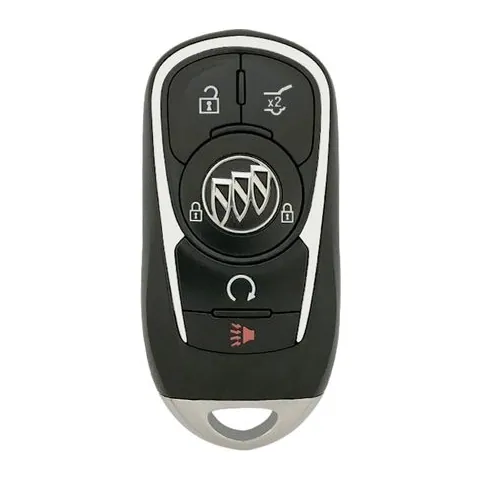
3/4/5-button Proximity Key
Find on Amazon- FCC ID
- HYQ4EA
- OE part #
- 13506667, 13506668, 13511629, 13521090, 13530511, 13532384 +10 more
- Frequency
- 433 MHz
- Chip
- PHILIPS ID 46 GM EXT
Remote Head Key
2 versionsOne piece: a cut metal blade with the lock/unlock buttons built into the head.
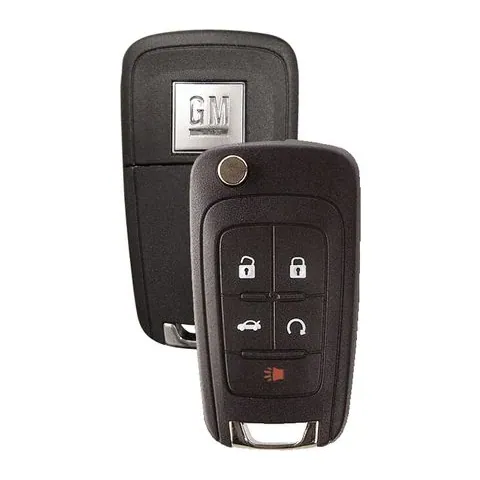
5-button Remote Head Key
Find on Amazon- FCC ID
- OHT05918179, P4O9MK74946931
- OE part #
- 13500224, 13500319, 13504202, 13504236, 13531359, 13584825 +7 more
- Frequency
- 315 MHz
- Chip
- PHILIPS ID 46
4/5-button Remote Head Key
Find on Amazon- FCC ID
- AVL-B01T1AC, AVL-B01T2AC, KR55WK50073, OHT01060512, V2T01060512, V2T01060514
- OE part #
- 13500221, 13500226, 13501514, 13504199, 13504204, 13504259 +15 more
- Frequency
- 315 MHz
- Chip
- PHILIPS ID 46 GM EXT
Photos show the OEM part for each number listed. Aftermarket replacements sold online are often slightly different in appearance — the FCC ID, not the shape, is what determines whether a fob will work with your car.
2019 Buick Regal key fob battery
Your 2019 Buick Regal key fob uses a CR2032 3V lithium coin cell. A fresh one typically lasts 3–5 years.
Find CR2032 batteries on AmazonHow to replace the battery
- 1 Slide the release latch and pull the metal emergency key out of the fob.
- 2 Use that key (or a coin) to pry the two halves apart at the seam.
- 3 Lift out the old coin cell — note which side faces up.
- 4 Drop in the new battery the same way (printed + side usually faces the back cover).
- 5 Press the case back together until it clicks, then test lock/unlock and push-to-start.
Battery tips
- Use a fresh, name-brand 3V lithium cell — bargain cells drain quickly.
- Even with a dead fob battery you can usually still start the car by holding the fob against the start button — check your owner's manual.
- If the fob still won't work after a new battery, it may need re-syncing or programming.
We may earn a commission on qualifying purchases made through links on this page, at no extra cost to you. It never affects which product we recommend. Learn more.
Rather hire a pro?
See what it actually costs, broken out by dealer, locksmith, and DIY: